

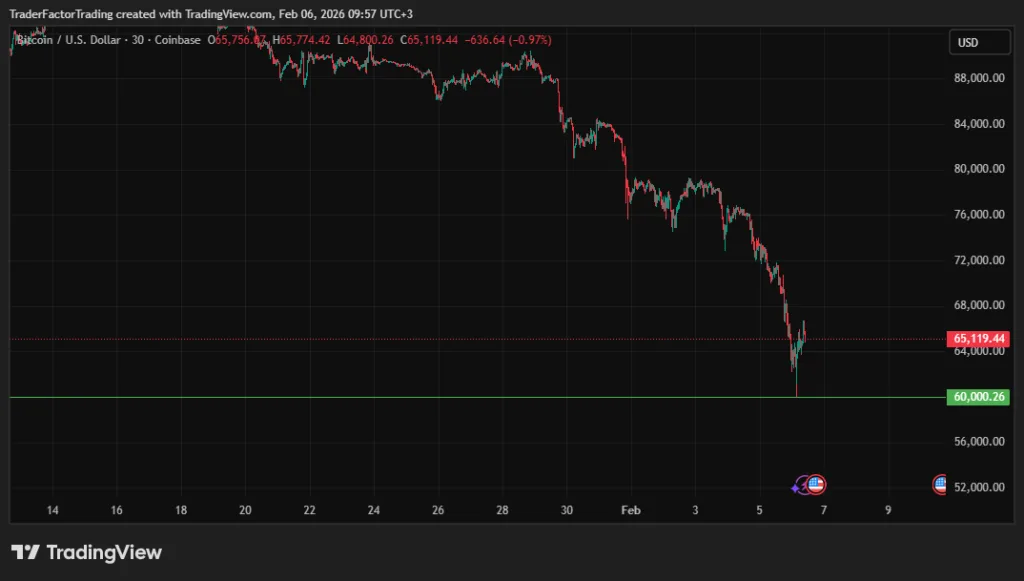
Bitcoin, the leading cryptocurrency by market capitalization, has plummeted to a 16-month low, trading near the critical $60,000 mark. This sharp decline represents a significant reversal from its peak in October 2025, when prices soared above $126,000.
.png)
The current downturn is being driven by a combination of factors, including a massive sell-off in technology stocks, tightening liquidity in global markets, and a notable retreat by institutional investors. As fear grips the digital asset space, over $2 billion in leveraged positions have been liquidated in just one week. Investors are now closely watching whether the $60,000 support level will hold or if further losses are on the horizon.
Market Overview: Bitcoin’s Sharp Decline
Examining the Price Drop and Volatility
The cryptocurrency market is currently experiencing intense selling pressure, with Bitcoin dropping nearly 30% in a single week. This bearish momentum pushed the asset below the psychologically significant $70,000 level, eventually touching a low of $60,062. This price point marks the lowest valuation seen since late 2024.
The sell-off is not isolated to crypto markets but is occurring alongside a broader decline in traditional risk assets, particularly U.S. technology stocks. Investors are reacting to renewed concerns about inflation and the potential for central banks to adjust interest rates, which often reduces the appeal of speculative investments. Consequently, the correlation between Bitcoin and traditional equities has strengthened during this period of stress.

Impact on the Broader Crypto Ecosystem
The ripple effects of Bitcoin’s struggles are being felt across the entire digital asset landscape. Major altcoins like Ether and Solana have also posted double-digit losses, signaling widespread weakness in the sector. Ether has pulled back significantly, while Solana hit a two-year low, underscoring the fragility of the current market structure.
The sheer volume of liquidations indicates that many traders were caught off guard by the speed of the decline. When prices fall rapidly, traders who borrowed money to bet on rising prices are forced to sell their holdings to cover losses, which creates a cascading effect that drives prices down even further. This cycle of forced selling has exacerbated the volatility, leaving market participants wary of entering new positions.

Institutional and Retail Sentiment Shift
Institutional Investors Reverse Course
For much of the previous year, large financial institutions were seen as a stabilizing force for Bitcoin prices, but that trend has reversed dramatically in recent months. Data indicates that U.S. exchange-traded funds, which had accumulated tens of thousands of Bitcoin last year, have now shifted to becoming net sellers in 2026. This change in behavior has created a substantial gap between supply and demand, adding persistent downward pressure on prices.
Analysts note that this institutional retreat is a major driver of the current bear market, as the deep pockets that once supported the asset class are now withdrawing capital. Without this steady stream of buying pressure, the market struggles to absorb the selling volume coming from other sources.

Retail Investors Grip Fear
Retail sentiment has followed the institutional lead, plummeting to extreme lows. The widely cited Crypto Fear and Greed Index has dropped to a reading of 9, a level not seen since the summer of 2022. This metric suggests that individual investors are extremely fearful and pessimistic about the near-term future of cryptocurrencies.
Such extreme readings often occur during capitulation events, where investors sell their holdings regardless of price to exit the market. The lack of retail enthusiasm is further evidenced by lower trading volumes on major exchanges, as casual traders step aside to wait for clearer signs of a recovery. This widespread caution suggests that it may take a significant catalyst to restore confidence among everyday investors.

Gold’s Performance Amid Crypto Volatility
Divergence Between Safe Havens
While Bitcoin faces severe headwinds, gold has demonstrated resilience and stability, reinforcing its traditional role as a safe-haven asset. The precious metal recently recovered to trade slightly above $66,000 after a brief dip near $61,000. This performance stands in stark contrast to the cryptocurrency market. Over the past year, gold futures have gained approximately 61%, while Bitcoin has lost nearly 40% of its value during the same timeframe.

This divergence challenges the narrative that Bitcoin serves as “digital gold” or a reliable hedge against market uncertainty. Investors seeking safety during this period of volatility appear to be favoring tangible assets over digital ones, contributing to the capital rotation we are currently witnessing.
Outlook and Key Levels
Analyzing Critical Support Zones
Market analysts are now focusing their attention on the critical support zone between $60,000 and $70,000. If Bitcoin fails to hold the $60,000 level, technical analysis suggests the potential for further significant declines. However, on-chain data offers a glimmer of hope for bulls, indicating that the market might be nearing a cyclical bottom.
The convergence of supply in profit and loss is a metric that has historically signaled major lows in previous cycles. If this pattern holds true, the current price levels could represent an accumulation opportunity for long-term investors. Nevertheless, the market remains fragile, and any further negative macroeconomic news could easily invalidate this bullish thesis.

The Role of Regulation and Macro Factors
Looking ahead, the path for Bitcoin will likely depend on external factors such as regulatory developments and macroeconomic shifts. Clearer regulations could provide the stability needed to bring institutional investors back into the fold. Conversely, continued uncertainty regarding interest rates and economic growth could keep risk assets suppressed for an extended period.

Analysts believe that without a new narrative or positive catalyst, the market may struggle to regain its upward momentum. Therefore, traders are advised to monitor government policy announcements and central bank statements closely, as these will likely serve as the primary drivers of price action in the coming weeks and months.
Conclusion
Bitcoin’s drop to a 16-month low highlights the severe challenges currently facing the cryptocurrency market. With institutions selling and retail sentiment at historic lows, the immediate outlook remains uncertain. As the market tests the $60,000 support level, investors must navigate a volatile landscape defined by liquidity stress and shifting economic conditions.

Disclaimer:
All information has been prepared by TraderFactor or partners. The information does not contain a record of TraderFactor or partner’s prices or an offer of or solicitation for a transaction in any financial instrument. No representation or warranty is given as to the accuracy or completeness of this information. Any material provided does not have regard to the specific investment objective and financial situation of any person who may read it. Past performance is not a reliable indicator of future performance.
FOLLOW US


No comments:
Post a Comment